|
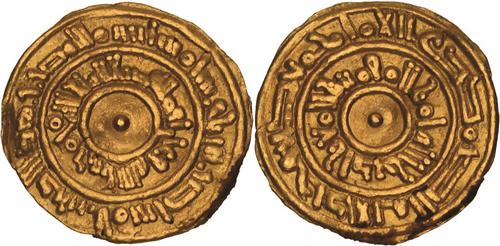
Fatimids. al-Mu'izz li-Din Allah. AH 341-365 / AD 953-975. AV Quarter-Dinar (14.9mm, 1.05 g, 11h). Nicol Type C. Sirt mint. Dated AH [35]6 (AD 966/7). Minor deposit. Good VF. Of the highest rarity, apparently unpublished and believed unique.
The mint-name on this unique coin comprises two elements: an uncertain word beginning with al- followed by the place-name read here as Sirt (without the definite article). This is unusual, and mint-names on mediaeval Islamic coins are not normally constructed in this way. Compound mint-names are generally either formed from two nouns in apposition, such as ‘Madinat Balkh’ or ‘Thaghr Qazwin’ or ‘Ma‘din Bajunays’, or else from a toponym followed by a noun or adjective prefaced by al-, such as ‘Madinat al-Salam’ or ‘Balkh al-Bayda’ or ‘Baldat al-Iqbal’. Even a form like ‘al-Qahira al-Mahrusa’ or ‘al-Mu‘izziya al-Qahira’ requires that both components of the name have the definite article. On the present coin, therefore, the construction of the mint-name suggests that it must mean ‘the [something] of Sirt’, with the unread word presumably being a noun or noun phrase.
Sirt was the Arabic form of the ancient place-name Syrtis. There were two places of this name in antiquity, known as Syrtis Major (in Libya) and Syrtis Minor (in Tunisia), and it is the former, known also as Syrtis Megale in Greek, which appears to be denoted here. It is thus possible that the unread word before the mint-name might be an equivalent of ‘Major’ or ‘Megale’. Alternatively, Syrtis Major was notorious for its dangerous sandbanks - Strabo noted that ‘in many places the water is shallow....when the tides rise and fall, ships sometimes fall into the shallows and settle there, and it is rare for them to be saved’ - it might conceivably be connected with the Arabic word shatt‘, meaning ‘beach’ or ‘coast’.
Support for reading the mint-name itself as Sirt comes from the fact that the city was being fortified by the Fatimid caliph al-Mu‘izz at the time this coin was struck:
‘It may be noted that the first three Fatimid Caliphs made three attempts to conquer Egypt and all of them failed. They realised that the lines of communication were too long and too weak. Troops required food, water and strong fortifications
on the invasion route. Al-Mu‘izz, on his accession to the Caliphate at al-Mahdiyya in 341 AH / 952 AD, began responding to this need. According to the celebrated Andalusian wazir and man of letters, Lisan al-Din ibn aI-Khatib, al-Mu‘izz built a
fortress at every thirty miles between al-Mahdiyya and Egypt. ‘Ali ibn Sa‘id al-Maghribi adds that the route from Surt to Fayyum in Egypt is the shortest and that al-Mu‘izz built several cisterns along it to store rain-water for his troops and to
facilitate their access to Egypt. Al-Maqrizi gives the date of the building of fortresses and the digging of wells as 355 AH / 965 AD. It is likely that the forts at Surt were built at this time, and we can relate the existence of several cisterns and wells at Surt and Ajdabiya to al-Mu‘izz’s Egyptian enterprise and to the year 355 AH / 965 AD. As noted above, al-Mu‘izz would have had the mosque of Surt rebuilt or restored at some time between his accession in 341 AH / 952 AD and 355 AH / 965 AD. The presence of a large cistern in the precincts of the mosque could be dated to his reconstruction.’ (Hamdani, A., ‘A History of Surt’, in E. Savage (ed). Excavations at Surt (Medinat al-Sultan) Between 1977 and 1981, pp. 15-16). Hamdani further notes that a coin of al-Mu‘izz was found during excavations on the site of the mosque at Sirt.
The date on the present coin is truncated, but ends with the numeral ‘6’ - presumably for AH 356. This places the year of its striking exactly when Sirt would have been involved with preparations for al-Mu‘izz’s final conquest of Egypt.
The final winners of all lots in Session One of CNG Islamic Auction 15 will be determined during the live sale held on 28 October 2026.
Session Two of CNG Islamic Auction 15, a timed online sale, will be held on Thursday, 29 October 2026, beginning at 2:00 PM GMT.
Winning bids are subject to a 22.5% buyer's fee for bids placed on this website and in person at the public auction, 25% for all others.
We recognize that our users may have various Internet Browsers and Operating Systems. We like our visitors to have the best possible experience when using our bidding platform. However, we do recognize that it is impossible to develop applications that work identically, efficiently and effectively on all web browsers. The CNG bidding platform supports the latest stable major version and stable previous version of Chrome and Firefox.
|