|
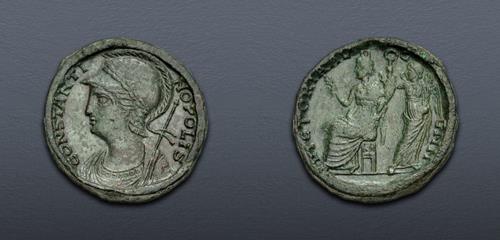
Commemorative Series. AD 330-354. Æ Medallion (29.5mm, 22.70 g, 12h). Rome mint. Struck AD 340-347. CONSTANTI NOPOLIS, laureate, helmeted, and mantled bust of Constantinopolis left, holding scepter over shoulder / VICTORIA AV G G NN, Constantinopolis, turreted, seated left, holding olive branch and cornucopia, being crowned by Victory, to right, standing left, holding wreath and palm frond. Gnecchi II 8; Ntantalia 11 (V7/R8); Kent 14. Dark green patina, smoothed, some tooling, edges hammered as a proto-contorniate. Good VF. Very rare.
From the W. Toliver Besson Collection. Ex Roma E-Sale 23 (9 January 2016), lot 633; Gorny & Mosch 224 (13 October 2014), lot 688.
In AD 324, Constantine I the Great selected the Greek city of Byzantium on the Bosphorus as the site of a new capital city to replace Rome, which he had come to believe was too distant from the Roman Empire’s wealthy eastern provinces and the strategically vital Balkans. Originally dubbed New Rome, the city was superbly situated at the crossroads of Europe and Asia, and would, he hoped, provide a fresh start for the empire under the newly favored Christian faith. The formal transfer came on May 11, AD 330, at which time the new capital was already being called Constantinopolis after its founder. Embellished by successive emperors and controlling trade between the Mediterranean and Black Sea, Constantinople swiftly became the wealthiest and most populous city in the world. During the reign of Theodosius II (AD 402-450), a formidable set of massive fortifications was constructed, making the city nearly invulnerable to attack by the siegecraft of the day. Throughout the fourth and fifth centuries, the East Roman Empire throve while the Western half succumbed to barbarian invasion and economic collapse.
This bronze medallion, intended as a handout to favored officials, was struck at the Rome mint during the joint reign of Constantine’s sons, Constantius II and Constans (AD 340-350). It reaches back to the pagan past to present Constantinopolis as an armor-wearing goddess, a virtual twin of Roma, venerable female personification of Rome. While Christian imagery had already begun to appear on Roman coinage, none is present here: The reverse depicts Constantinopolis, now dressed in civilian garb and wearing a turreted headdress similar to that of Tyche, seated to left and crowned by Victoria, another pagan goddess, along with a legend celebrating the “victories of our emperors.” Intriguingly, the edge was subsequently hammered up, perhaps in the early fifth century, turning the piece into a contorniate, a type of medallion or token issued in conjunction with public festivals and games during the late Roman Empire.
Closing Date and Time: 22 July 2026 at 11:28:40 ET.
Winning bids are subject to a 22.5% buyer's fee for bids placed on this website, 25% for all others.
|