|
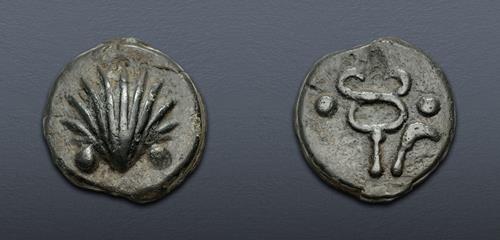
Anonymous. Circa 240 BC. Æ Aes Grave Sextans (36mm, 49.27 g, 6h). Sickle series. Rome mint. Scallop-shell; •• (mark of value) across field / Caduceus; sickle to right, •• (mark of value) across field. Crawford 25/8; ICC 52; HN Italy 304; RBW 45. Dark green patina with earthen highlights, flan crack, slight roughness, casting void on reverse. Good VF.
From the W. Toliver Besson Collection. Ex Plus 20 Collection (Classical Numismatic Group 130, 23 September 2025), lot 389 (hammer $3000); Numismatica Ars Classica 138 (18 May 2023), lot 326; Künker 124 (16 March 2007), lot 8215; Lanz 72 (29 May 1995), lot 335.
The story of Rome’s adoption of bronze coinage is a complex one. While the Roman Republic was officially founded circa 510 BC, its rather rustic population resisted the Greek innovation of coined money for more than two centuries before an abortive start in the last quarter of the fourth century BC. This consisted of small bronze coins bearing a head of Apollo and a man-headed bull reverse, along with the Greek legend ΡΩΜΑΙΩΝ. Likely produced under contract at the Campanian Greek city of Neapolis, these circulated very little, and seemingly outside of Rome proper. When the Romans resumed issuing bronze coins circa 280 BC, they looked not toward the Greeks, but toward the Etruscan- and Oscan-speaking peoples of the Italian heartland, who already had an established system utilizing huge coins of literal, as opposed to fiduciary, value. Rather than being produced by hammer and dies, these Aes Grave (”heavy bronze”) coins were created by pouring molten bronze into a mold, resulting in a roughened surface scant in fine detail. Hence, the designs were simple and crude by the standards of the Greeks. The main denomination, or As, weighed in at a full Roman pound, or about 325 grams of leaded bronze. Denominations included the As, Semis (half), Triens (third), Quadrans (quarter), Sextans (sixth), and Uncia (twelfth). Practical considerations resulted in a staged reduction in weight. By circa 240 BC, when this sextans was produced, the As now weighed somewhat less than 300 grams, as a quick calculation of this piece at 49.27 grams times six will show. By 225 BC, the Roman As weighed in at a still-hefty 275 grams. Despite the evident clumsiness in using such large pieces in everyday commerce, the Romans and their Italian allies clung to the unwieldy Aes Grave system until midway through the Second Punic War, circa 217-211 BC, when it was gradually replaced by a series of struck bronze denominations on a much reduced fiduciary standard.
Closing Date and Time: 22 July 2026 at 11:09:20 ET.
Winning bids are subject to a 22.5% buyer's fee for bids placed on this website, 25% for all others.
|