|
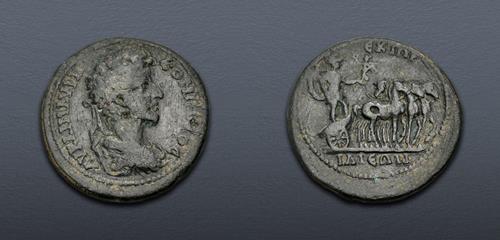
TROAS, Ilium. Commodus. AD 177-192. Æ Dupondius (36mm, 21.67 g, 7h). Struck circa AD 180-182. Laureate, draped, and cuirassed bust right, seen from behind / Hector, helmeted, standing in slow quadriga right, holding Nike who crowns him with a wreath, spear, and shield. Bellinger T185; RPC IV.2 Online 121.3 = Ramage 102 (this coin); von Fritze, Ilion 78 var. (rev. variety). Dark brown patina, scratches. Near VF. Very rare.
From the Dr. Mark Staal Collection. Ex Cornelius C. Vermeule Collection (Stack’s, 11 January 2010), lot 265; David Simpson Collection (Triton V, 16 January 2002), lot 1720; Crédit Suisse 8 (27 October 1987), lot 1209.
For nine years in the Trojan War, the fortunes of both sides ebbed and flowed. During the tenth year, Achilles, upset over the loss of the woman Chryseis to Agamemnon, the commander of the Greeks, withdrew to his tent and refused to fight. The loss of the greatest of the Greek warriors allowed the Trojans under the command of Hector, the eldest son of Priam, to gain the upper hand. At that point, Patroclus then offered to put on Achilles’ armor in order to rouse the Greeks to fight. Thinking that Achilles had returned to battle, Hector dashed out on to the field of battle in his chariot (Hom. Il. 16. 367-369):
Ἕκτορα δ᾽ ἵπποι // ἔκφερον ὠκύποδες σὺν τεύχεσι, λεῖπε δὲ λαὸν // Τρωϊκόν, οὓς ἀέκοντας ὀρυκτὴ τάφρος ἔρυκε. ("But the swift-footed horses did carry forth Hektor with his equipage, and he left behind the Trojan host, whom unwilling the excavated trench held back.")
Hector killed the clearly ill-matched Patroclus, and, in order to avenge his friend, Achilles returned to the field to slay Hector.
Closing Date and Time: 3 June 2026 at 13:21:40 ET.
All winning bids are subject to a 20% buyer’s fee.
|