|
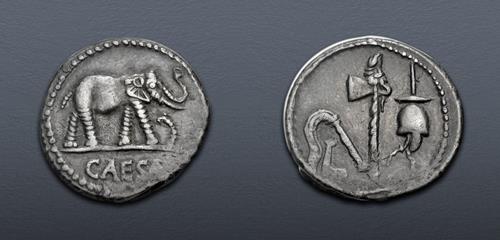
Julius Caesar. April-August 49 BC. AR Denarius (18mm, 3.98 g, 12h). Military mint traveling with Caesar. Elephant advancing right, trampling on horned serpent / Emblems of the pontificate: simpulum, aspergillum, securis, and apex. Crawford 443/1; CRI 9; Sydenham 1006; RSC 49; RBW 1557; SCBC 456. Old cabinet toning, areas of weak strike. VF.
From the David C. Bianchi II Collection, purchased from C.H. Wolfe, January 1981.
Beginning during the latter imperatorial period during the campaigns of Julius Caesar, Roman interest and influence in Britannia grew throughout the next three centuries. Many emperors were personally involved in campaigns, which were often commemorated on their respective coinages.
The first Roman incursions into Britain were led by Julius Caesar in 55 BC and 54 BC and were intended as a response to the British tribes’ support for the Gauls. While no permanent presence was established on the island, it did draw the Britains further into the Roman world and set the stage for the conquest a generation later. No coins were struck by Caesar commemorating this event (but see lot 1 for a denarius of Caesar from a traveling military mint).
During the reign of Claudius, Verica, king of the Atrebates and ally of Rome, was forced into exile by invasions of the Catuvellauni, a neighboring tribe to the east. This served as the pretense for Claudius’ invasion of Britannia in AD 43, led by the general Aulus Plautius, who subsequently served as governor of the region (the future emperor Vespasian also ranked among the commanders). While Claudius had some participation in the campaigns–bringing reinforcements and elephants to Camulodunum–and received a triumph after his return to Rome, he refused the title Britannicus. The success of these invasions was commemorated on various issues. One, an issue of aurei and denarii (lot 5), depicts the two triumphal arches erected by the Roman Senate–one in Gaul and the other in Rome–in honor of these momentous victories. So momentous was the successful establishment of Roman rule in Britain that Claudius celebrated it even on a provincial issue from the far eastern mint in Cappadocia.
The next emperor to directly commemorate Roman rule in Britain was Hadrian, who, between the years AD 119 and 136, traveled throughout the Roman Empire, visiting various provinces to take stock of his inheritance and calm the disquiet which had arisen in the later years of Trajan's reign. The first tour was specifically designed to shore-up Rome's northern borders. Hadrian first visited the provinces of Gaul and Germania, then crossed the Channel to Britannia where, during his stay, construction began on a seventy-three-mile long wall across the north of the province, known to this day as Hadrian's Wall. All of the provinces he visited were commemorated on various issues of coinage, and in multiple denominations. An as depicting a figure of Britannia was struck during his reign (lot 14).
Under Antoninus Pius, revolts in Britannia were again a focus of the emperor’s concerns, as one of Pius' first actions was to send Q. Lollius Urbicus, a previous governor of Germania Inferior, to Britain to quell a number of revolts. While most of the sources note the Brigantes (located in Northumbria) as the primary focus of these events, circa AD 143-144, most of his campaigning was against the lowland tribes of Scotland–the Votadini, Selgovae, Damnonii, and Novantae. His campaigns were successfully completed by AD 144, after which Urbicus and the Legio II Augusta built the Antonine Wall. These victories were commemorated on issues of sestertii and asses (lot 15-16).
Four decades later, Commodus issued coins to commemorate the victories in Scotland of the governor Ulpius Marcellus in 184-185 (lot 17). These campaigns were in response to a major barbarian invasion several years earlier that in significant damage to Hadrian's Wall, which had been temporarily overrun, and the defeat and death of the Roman governor.
The Severan period saw the issuance of the greatest number of coin types celebrating Roman campaigning in Britannia. As can be seen on an array of silver and bronze issues (lots 20-24, 26-28, 30), Septimius Severus’ last military campaign against the Caledonians on the northern border of Britain was decisive in its role on Roman coinage, with Severus himself dying at his campaign headquarters at York in February AD 211. Among those who accompanied him on the campaign were his wife, Julia Domna, and his two quarrelsome sons, Caracalla and Geta, who also figured prominently in this series of British victory coinage.
After a hiatus of related types for nearly the remainder of the third century AD, Britannia-themed iconography returned for a final time during the brief Romano-British empire of Carausius and Allectus. Isolated from the expanse of the eastern and western branches of the Roman empire, Britannia was seized by one of her generals, Carausius, who was succeeded by one of his own generals, Allectus. Their coins were the first issues to be struck at an official Roman mint in Britain, and some issues had reverse types that were local in character. For instance, a very small number of Carausius’ issues feature the emperor clasping hands with Britannia, here at long last represented as the personification of the homeland rather than as a foreign possession (see lots 33-36 for general issues of these two Romano-British emperors). Following the death of Allectus and Britannia’s reunification with the Roman empire, the number of locally inspired motifs ended entirely. Nonetheless, the mint at Londinium (London) that was established under Carausius was maintained, and fulfilled the need for coinage in Britannia and the west during the first quarter of the fourth century AD (lots 31-31, 37, 39).
Closing Date and Time: 20 May 2026 at 10:00:00 ET.
Winning bids are subject to a 22.5% buyer's fee for bids placed on this website, 25% for all others.
|