|
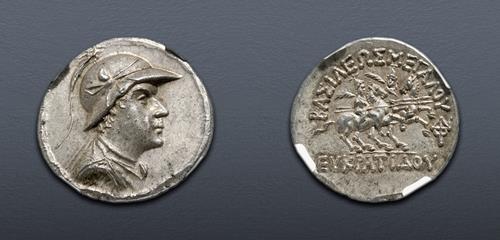
BAKTRIA, Greco-Baktrian Kingdom. Eukratides I Megas. Circa 170-145 BC. AR Tetradrachm (21mm, 17.00 g, 12h). Diademed and draped bust right, wearing crested helmet adorned with bull's horn and ear; bead-and-reel border / BAΣIΛEΩΣ MEΓAΛOY around, EYKPATIΔOY in exergue, the Dioskouroi, wearing cloak and tunic, each cradling palm frond in their left arm and holding couched spear in their right hand, on horses rearing right; monogram in lower right field. Bopearachchi 6E; Bopearachchi & Rahman 240-2; SNG ANS 465; MIG Type 177ee; HGC 12, 131. In NGC encapsulation 5872774-001, graded Ch MS, Strike: 5/5, Surface: 4/5.
Ex Heritage 3106 (17 January 2023), lot 33143.
True to his self-granted title, Eukratides Megas was perhaps the greatest of the Greco-Baktrian kings. His origins are obscure; he seems to have been the son of one Heliokles and a woman named Laodike, who may have been related to the Diodotid or Seleukid royal houses. This tincture of blue blood enabled him to attain a leading position in the army or civil service of the Greco-Baktrian realm, which had by circa 170 BC broken into several sub-kingdoms ruled by Antimachos I and II, Apollodotus I, and Demetrios II. Eukratides revolted against Demetrios and, despite being heavily outnumbered, succeeded in seizing his throne. Then, methodically, he defeated the other Baktrian rulers and annexed their realms, ultimately assuming the title Megas (“Great”). Only Menander I Soter, who controlled northern India, seems to have held out against him. Often depicted on his coins wearing a broad-brimmed helmet, his image spread far and wide, and the splendor of his reign was noticed by the Hellenistic states far to the west. The second century AD historian Justin wrote a brief, garbled account of his reign, noting that he “carried out several wars with great spirit,” but that he ultimately was murdered by one of his own sons while on campaign: “He was killed on his march by his son, with whom he had shared his throne, and who was so far from concealing the murder... he drove his chariot through his blood, and ordered his body to be cast out unburied.” Which of his three sons (Eukratides II, Plato and Heliokles I) carried out the patricide remains a mystery.
This lot, along with the following three, were all struck from the same obverse die, known for the Í mint. In this sale, these coins are arranged by die state of the obverse.
The final winners of all Triton XXIX lots will be determined at the live public sale that will be held on 13-14 January 2026.
Triton XXIX – Session Two – Lot 302-613 will be held Tuesday afternoon, 13 January 2026 beginning at 2:00 PM ET.
Winning bids are subject to a 22.5% buyer's fee for bids placed on this website and 25% for all others.
We recognize that our users may have various Internet Browsers and Operating Systems. We like our visitors to have the best possible experience when using our bidding platform. However, we do recognize that it is impossible to develop applications that work identically, efficiently and effectively on all web browsers. The CNG bidding platform supports the latest stable major version and stable previous version of Chrome and Firefox.
|