|
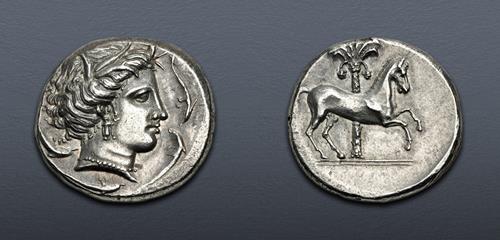
SICULO-PUNIC, “The Camp”. Circa 345/38-320/15 BC. AR Tetradrachm (26mm, 17.21 g, 12h). Possibly Entella mint. Head of Arethousa right, wearing wreath of grain ears, triple-pendant earring, and pearl necklace; four dolphins around / Horse prancing right; palm tree in background. Jenkins, Punic, Series 2d, 131 (O44/R118); CNP 213; HGC 2, 281; Gulbenkian 366 (same dies); McClean 3043 (same dies). Lightly toned, underlying luster, faint scratch on obverse. EF. Fine style.
Ex Peter Bowe Collection; Berk BBS 185 (9 July 2013), lot 75; Gemini X (13 January 2013), lot 24; Triton IV (5 December 2000), lot 123; Schweizerische Kreditanstalt 8 (27 October 1987), lot 730.
The Siculo-Punic coinage in Sicily, which included the minting of Attic-weight standard tetradrachms and didrachms within Sicily by Carthage, is linked primarily to five cities: Motya, Panormos, Lilybaion, Entella, Solous, and Thermai Himerenses. Entella has been identified as the site of the main Punic controlled mint on the island, but that is disputed and it is often referred to as “uncertain.” Thermai Himerenses and Solous were minor mints that issued only a few tetradrachms along with silver fractional and bronze issues. Motya, once the leading Punic city and mint in the area, ceased production after its destruction in 397 BC. This left Entella, Panormos, and Lilybaion as the major remaining mints, with Entella issuing the majority of the subsequent Punic coinage.
This coinage is directly tied to Carthage’s attempts to subjugate the eastern Greek half of the island. The first Sicilian War saw Carthage crushed at the Battle of Himera in 480 BC, and for seventy years after Carthage declined to interfere in Greek Sicilian politics even when called upon. However, this stance changed with her intervention on behalf of Segesta against Selinos and Himera in the Second Sicilian War. Notably, before Punic intervention, Carthage did not mint any coins at all. Instead, Punic trade across the Mediterranean was conducted in kind rather than with currency. However, Carthage needed to hire mercenaries to bolster her armies in her quest to conquer Sicily and this required currency that the mercenaries would trust.
The earliest Siculo-Punic tetradrachms had a distinctly Punic style that did not match with current issues circulating on the island. Subsequent Carthaginian emissions, however, copied local imagery and style, producing tetradrachms and didrachms that denizens of the island were familiar with. This allowed them to easily integrate into circulation alongside the Greek issues in Sicily. This syncretism, which Carthage practiced in other areas, produced a body of coinage that is fascinating not only due to its beauty, but also because of the amalgamation of styles and cultures. This model would be adopted for almost all of the Punic coinage minted in Sicily. The coins were identified as inherently Punic by alterations in style or use of a Punic legend or symbol such as the horse. However, the core concepts of the coins were borrowed from Syracuse, Akragas, Himera, and other Greek cities in Sicily. Even in Carthage’s last issue of Herakles head tetradrachms, we see the use of prototypes from Alexander’s different mints in the East. This confluence of cultures is what makes the series interesting to collect outside of its beauty and history: the ability to buy one coin that has elements from three or even four cultures is difficult to beat and is attractive to collectors of almost any area.
The final winners of all Triton XXIX lots will be determined at the live public sale that will be held on 13-14 January 2026.
Triton XXIX – Session One – Lot 1-301 will be held Tuesday morning, 13 January 2026 beginning at 9:00 AM ET.
Winning bids are subject to a 22.5% buyer's fee for bids placed on this website and 25% for all others.
We recognize that our users may have various Internet Browsers and Operating Systems. We like our visitors to have the best possible experience when using our bidding platform. However, we do recognize that it is impossible to develop applications that work identically, efficiently and effectively on all web browsers. The CNG bidding platform supports the latest stable major version and stable previous version of Chrome and Firefox.
|